The Central Coast dry ice cleaning specialists.
Engine bays, restoration, food production, marine and industrial cleaning — chemical-free, water-free, residue-free professional service. Get a fixed quote within 24 business hours.
- Central Coast NSW — Sydney to Newcastle
- Mobile to your driveway, workshop or site
- Fixed quote within 24 business hours
- Public liability insured to $20m
How to book a job
Two ways — pick whichever's faster for you.
Option 1 — Form
Tell us what you need cleaned. Fixed quote back within 24 business hours.
Send a briefServices we deliver
From engine bays to insurance restoration, food production to marine — pick a category to see what we cover.
Mold Remediation
Remove mold from timber, masonry and HVAC without chemicals — fast, documented, IICRC-aligned.
Fire & Smoke Damage
Strip soot from timber, masonry and contents without sanding, sandblasting or chemical washing.
Food Production Cleaning
HACCP-aligned, food-grade cleaning of conveyors, ovens, mixers and packaging lines.
Manufacturing Equipment Cleaning
In-place cleaning of presses, moulds, robots and production cells — no tear-down required.
Antifoul Stripping
Strip layered antifoul from hulls without sandblasting damage or chemical run-off.
Electrical Equipment Cleaning
De-energised switchgear, motor and panel cleaning — no water, no solvent, no drying time.
Heritage Restoration
Lift soiling, biological growth and overpaint from heritage stone, brick and timber.
A clean that disappears as it works.
Three things happen at once when a pellet hits a contaminated surface — and the result is the cleanest non-abrasive process available.
Pellets sublimate on contact
We blast solid CO₂ pellets at the contamination. The pellets sublimate — turn instantly to gas — when they hit the surface.
Contamination lifts away
No water, no chemicals, no abrasive media residue. Just the contamination, lifted off and falling clear of the surface.
Surface stays intact
Original paint, decals, electrical components and food-grade surfaces are unaffected. There’s nothing left to dry, rinse or clean up.
Recent documented work
Real jobs, our own photos — before, during and after.
A floor-standing commercial gas fryer, in service for years and recently decommissioned because it was too dirty to keep using, caked in carbonised oil, grease and surface rust — cleaned back to bright stainless with dry ice at Shelly Beach Golf Club on the Central Coast — no water near the gas train, no caustic, no abrasive left in the vat.
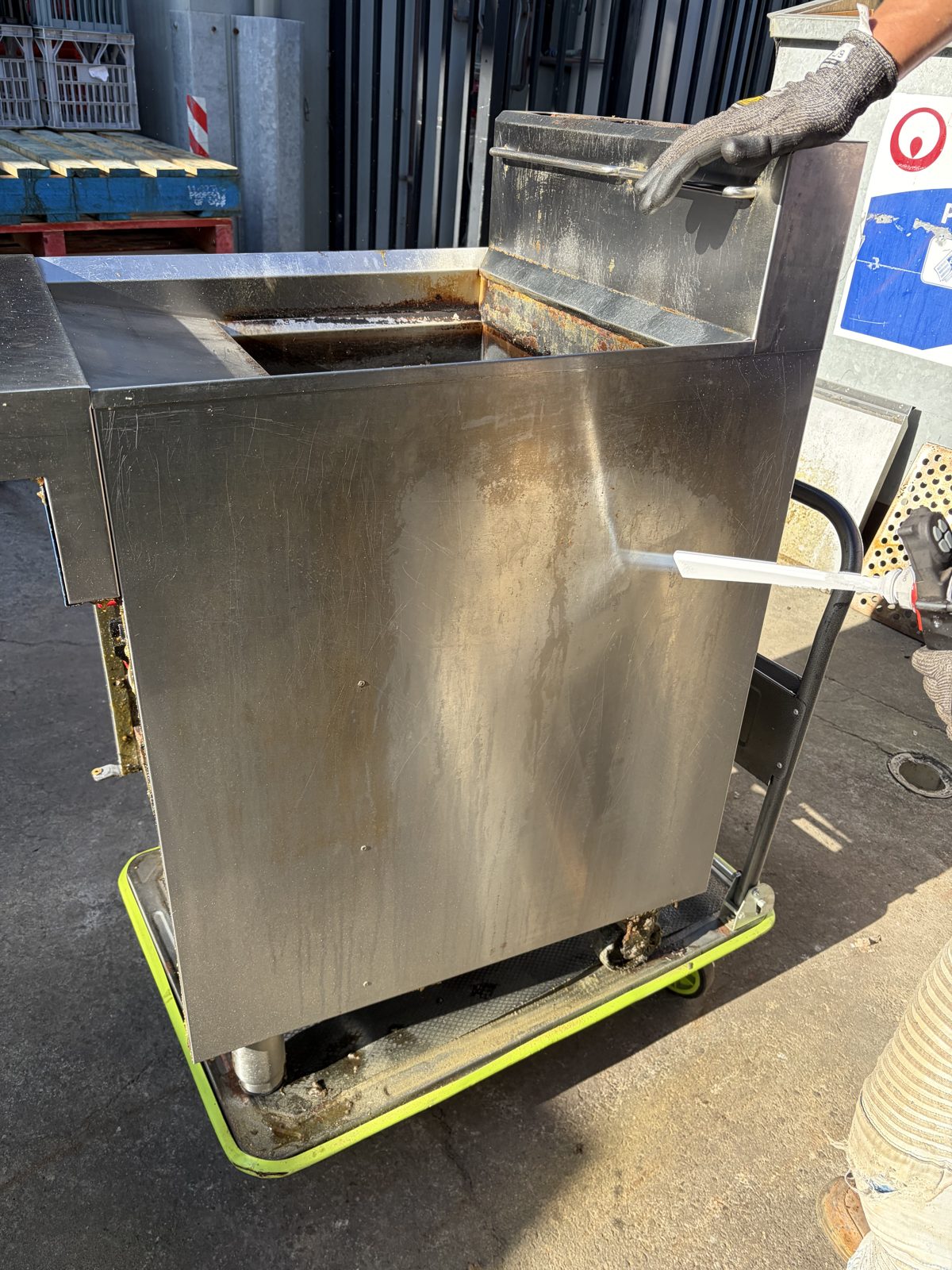
Commercial Deep Fryer Brought Back to Life — Shelly Beach Golf Club
Floor-standing commercial gas deep fryer
A full day under a silver 996 on a four-post lift at a Central Coast fabrication workshop: two decades of road film, oil mist and surface corrosion lifted off the engine underside, gearbox, subframes and undertray — no water, no chemicals, no media left in the chassis.
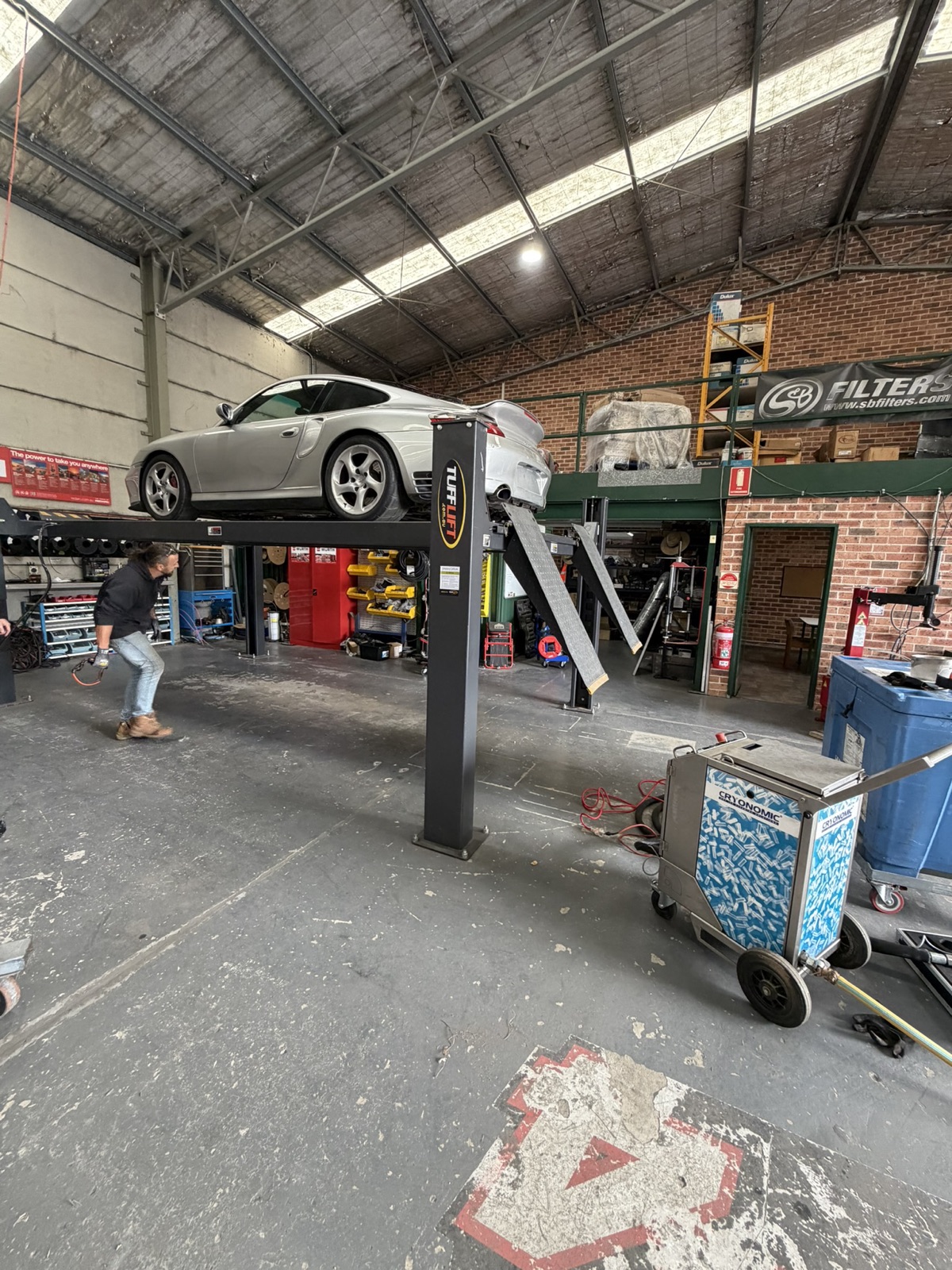
Porsche 911 (996) — Underbody and Wheel-Arch Dry Ice Clean
Porsche 911 (996), silver — mid-project
Why dry ice vs traditional methods.
For most professional cleaning where surface integrity, residue or downtime matter — dry ice wins on the issues that decide the outcome.
| Feature | Dry Ice | Steam | Chemical | Sandblasting |
|---|---|---|---|---|
| Water residue | ||||
| Chemical residue | ||||
| Surface damage risk | Very low | Low | Medium | High |
| Disassembly required | Sometimes | Often | Often | |
| Non-conductive, no drying time (isolated equipment only) | ||||
| Hot-clean ovens (no cool-down) | ||||
| Environmental impact | Minimal | Detergent run-off | High — waste handling | High — media disposal |
Industries we serve
Specialised programs for the verticals that need them.
Auto Detailing
Add dry ice cleaning to your studio without owning the gear.
Insurance & Restoration
Documented, IICRC-aligned dry ice cleaning for fire, mold and water-damage loss work.
Food & Beverage
Hot-clean ovens, conveyors and packaging lines without chemicals — HACCP-aligned, allergen change-over capable.
Marine & Boating
Antifoul, bilge and engine-room cleaning that doesn’t damage the boat.
Manufacturing & Industrial
Cleaner equipment, less downtime, no tear-down.
Government & Heritage
A heritage-authority-recognised method for stone, masonry and graffiti.
Electrical & Utilities
Short shutdown, no drying time — switchgear, motors and substation equipment cleaned in your isolation window.
Aviation & Transport
Engines, gear bays, traction motors — cleaned to maintenance-grade without solvent.
Servicing the Central Coast — Sydney to Newcastle
Based on the Central Coast, mobile to Sydney and Newcastle. Same standards across the corridor.
Common questions
The questions we get asked most often. Service-specific questions are answered on each service page.
What is dry ice blasting?
Dry ice blasting is a non-abrasive industrial cleaning method that uses pellets of solid CO₂ (dry ice) accelerated with compressed air. The pellets sublimate — go from solid directly to gas — when they hit the surface, lifting contamination away in a single pass without water, chemicals or abrasive media residue.
How is it different from sandblasting or steam cleaning?
Sandblasting uses abrasive media that erodes the surface and leaves grit residue everywhere. Steam cleaning uses water and detergent, leaving moisture in connectors, looms and porous materials. Dry ice is non-abrasive and 100% dry — the only "residue" is the dirt that fell off.
Is dry ice cleaning safe for electrical components?
Yes, on isolated equipment. CO₂ pellets are non-conductive and leave no residue, so there's no drying time before your electrician re-energises. We only blast electrical equipment that has been isolated and proven de-energised by a licensed electrical worker — we do not clean live electrical equipment.
Will it damage paint, decals or original finishes?
No — when applied at the right pressure. Dry ice removes contamination layered on top of a finish without disturbing the finish itself. We tune pressure per surface and test on inconspicuous areas first for any sensitive job.
How long does it take?
It varies by service. Engine bay cleans typically run 2–4 hours, full-vehicle restoration 2–5 days, food production lines per shift, restoration zones per zone. Our quote form gives you a duration estimate after you tell it what you need.
How much does it cost?
A typical engine bay sits between $480 and $950. Restoration and industrial work is quoted per scope — send us a brief for a postcode-specific estimate, or request a quick quote and we’ll come back within 24 hours.
Where do you operate?
We service the Central Coast NSW corridor — Sydney up to Newcastle. Based at West Gosford, mobile to your site. See the locations page for the full coverage list including suburbs.
Do you come to me, or do I bring it to you?
For most jobs — auto detailing, restoration, marine — we come to you. For specialty work (concours preparation, body-off restoration) we use partner workshops with extraction. Industrial work is always on-site.
Get a free quote in 60 seconds.
Tell us what you need cleaned. We come back with a fixed quote within 24 hours — and an exact estimate range while you wait.
Or talk to us directly
- 02 5302 6367
- office@dryiceblasters.com.au
- Mon–Fri 7am–6pm · Sat 8am–2pm · Sun by appointment