The Classic Car Restorer's Handbook to Dry Ice Cleaning
A 4,500-word handbook for owners of classic and concours-grade vehicles. Surface-by-surface technique, decal preservation, photo-record protocols, and provenance documentation.
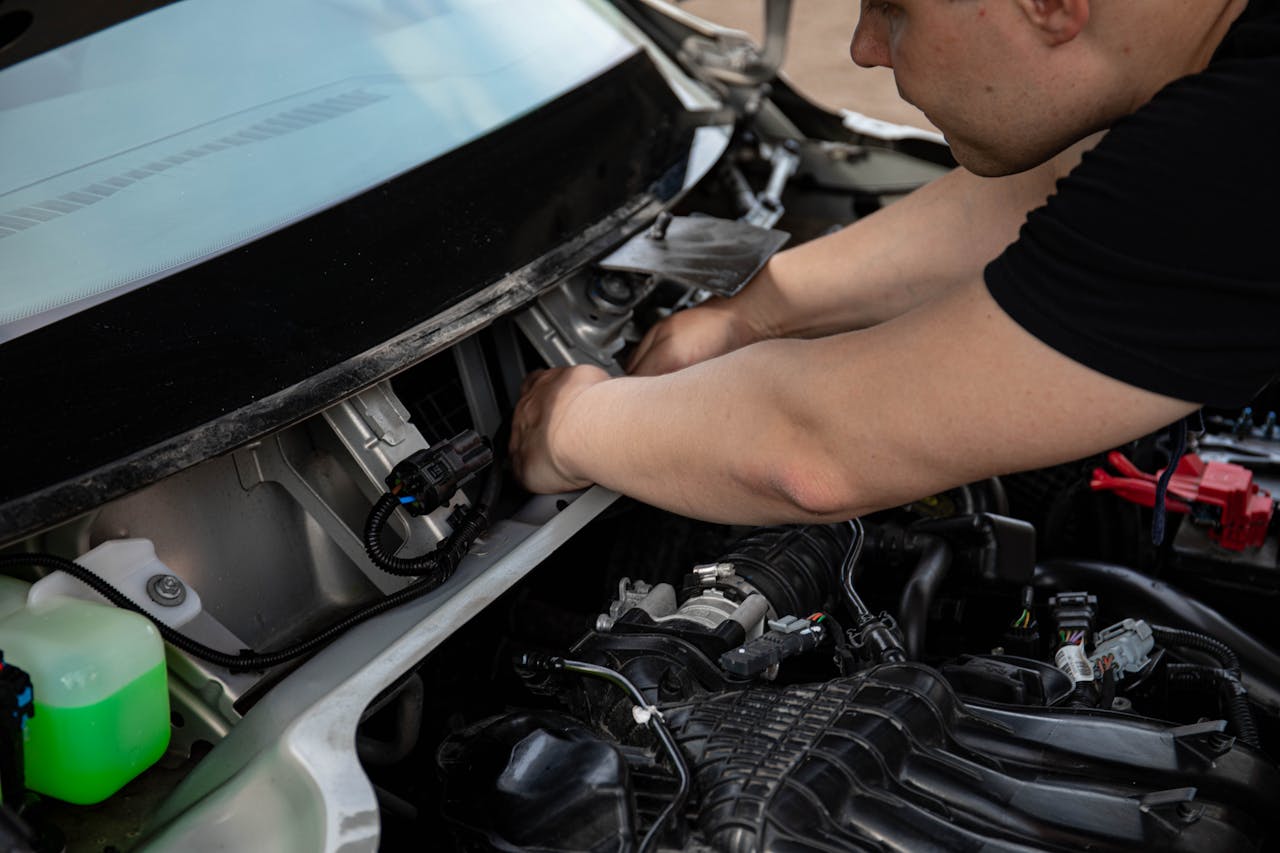
This handbook is written for one specific reader: the owner of a classic or concours-grade vehicle who’s evaluating dry ice cleaning for engine bay, undercarriage or full-vehicle work and wants to know — in detail — what to expect, what to ask for, and how to get the best result without compromising the original car.
You may have heard of dry ice cleaning at a car meet, seen before/after photos on Instagram, or had a workshop suggest it for a project car. The marketing is enthusiastic but vague. The technical detail isn’t widely shared. This handbook fixes that.
Why this isn’t a “detail”
Detailing chemistries — degreasers, citrus cleaners, plastic dressings — work by depositing surfactants on the surface, breaking grime’s bond, then rinsing. Even the best detail leaves a residue, and that residue traps the next layer of dirt. Two months later, your engine bay looks worse than before because the residue itself has now collected fresh contamination.
Dry ice cleaning is a fundamentally different process. CO₂ pellets, accelerated by compressed air, hit the contamination at -78°C and several hundred metres per second. Three things happen simultaneously:
- Thermal shock contraction — the contamination layer cools, contracts, and breaks its bond with the substrate underneath
- Kinetic impact — the pellet’s momentum dislodges the loosened material
- Vapour expansion — the pellet sublimates (solid to gas, no liquid phase) and expands to 800× its solid volume, blasting the contamination clear
The substrate stays intact because the pellet sublimates before it can abrade. The contamination falls away. There’s nothing left on the surface — no chemical residue, no water, no abrasive media. That’s the bit that matters for original cars.
Why original cars deserve different treatment
When your vehicle is a numbers-matching classic — 1968 Mustang Fastback, 1967 Camaro RS, GT-R Nismo Type R, 911S, vintage Aston, etc. — the reason it’s valuable is the original. Original paint codes stamped on the firewall. Original VECI sticker on the radiator support. Original “Powered by Ford” decal on the air cleaner. Original Hooters-issued shipping tag on the inside of the bonnet. Original pinstriping. Original everything.
Most cleaning processes erode at least one of those originals:
- Pressure washing lifts decals and pushes water into ECU connectors, distributors and looms
- Sandblasting scores polished aluminium and ruins original textures
- Soda blasting leaves alkaline residue that can affect later paint adhesion
- Chemical degreasing stains decals, dehydrates rubber, leaves streaks on plastic loom covers
- Hand cleaning with detail sprays leaves residue that traps the next dirt layer
Dry ice cleaning, done correctly, doesn’t do any of those. The pellets are softer than alloy, paint, plastic and decals at any useful pressure. They sublimate before they can abrade. There’s no chemistry to react with the substrate. There’s no liquid to migrate into electrical connectors.
Done correctly is the operative phrase. Most of this handbook is about what “correctly” looks like.
The pre-work walk-around
Before any pellets fly, the vehicle gets photographed. This sounds obvious but it’s the single most-skipped step in the industry. The reason it matters:
- Provenance — your car file gets a documented “before” baseline that’s useful at resale
- Insurance — pre-existing damage is recorded, not attributed to us later
- Customer alignment — you see what we see, agree on scope, agree on areas to avoid
We photograph every original marking — factory paint code stamps, VIN tag, build plate, decals, datamatrix labels, foundry marks on castings, pinstriping. We photograph every existing flaw — paint chips, hose deterioration, rusted connectors, oil leaks. We photograph every area we’ll need to mask.
The pre-work photo log goes into your job file and your handover pack. For concours-grade vehicles we can produce a printed photo book on request.
What we mask and why
Masking decisions are based on what you’d be unhappy to see post-work, not on what dry ice “could” damage. Standard concours masking:
- Factory decals — taped over with low-tack masking tape if positioned in pellet-impact zone
- Air intake — covered to prevent pellet ingress (rare but possible from pellet rebound)
- Distributor cap on points cars — covered to prevent moisture from rebounded pellet vapour
- Carb air horn — covered for the same reason
- Ignition leads — typically left uncovered; pellet impact won’t damage them
- Original wiring loom — uncovered; original loom tape and protective coverings are fine
- Plastic loom covers with original wear patterns — often uncovered, low pressure used
- VECI sticker / VIN plate — masked or low-pressure technique applied
The judgement calls are around things that have collector value beyond their function. A heritage paint code stamping is worth more than the firewall paint around it. We treat the stamping with extra care.
Pressure tuning per surface
Pellet pressure (more accurately: nozzle exit pressure, but pellet pressure is the working term) is the dominant variable in dry ice cleaning safety. Higher pressure = faster cleaning + higher risk to soft surfaces. Concours work uses lower pressure than industrial work, often by 30-50%.
Typical concours pressures across the engine bay:
| Surface | Pressure | Notes |
|---|---|---|
| Original decals | 60-70 PSI | Sample-test mandatory |
| Factory paint code stamping | 70-80 PSI | Don’t blast directly into the stamp |
| Plastic loom covers | 70-80 PSI | Remove without graining the plastic |
| Polished alloy (intake, plenum) | 100-110 PSI | Original textures preserved |
| Cast aluminium block / head | 90-100 PSI | Foundry marks preserved |
| Painted plenum | 80-90 PSI | Original paint texture preserved |
| Rubber hoses | 80-90 PSI | No dehydration concerns at this range |
| Chassis rails (engine-bay only) | 100-110 PSI | Higher than concours norm but contained |
| Firewall stampings | 70-80 PSI | Around stampings; not directly into them |
Sample-testing on an inconspicuous area is mandatory before applying full pressure to anything decal-bearing or value-original. We typically test on a hidden corner of the firewall or under the manifold.
The job — what actually happens
A typical concours engine bay clean runs 4-6 hours, of which 1.5-2 hours is preparation, 2-3 hours is blasting, and 30-45 minutes is hand-finish.
Hour 1 — Setup and prep.
- Vehicle on flat hard standing. No hoist needed for engine-bay-only work; a hoist makes underbody work easier.
- Battery disconnected (negative terminal first).
- Engine cool to the touch — not just warm, fully cool.
- Drop sheet under the engine bay.
- Pre-work photography (15-20 minutes).
- Masking applied per agreed plan.
- Compressor and pellet hopper set up. Pressure verified at the gauge.
Hour 2-3 — Pellet pass.
- Work top-down, back-to-front. Start with the inside of the bonnet and the firewall.
- Move to the cam covers, intake, and plenum.
- Move down to the chassis rails, around the suspension towers.
- Lower-pressure passes around decal areas.
- Pellet-density adjusted on the hopper for fine surfaces.
- Operator wears full PPE — eye, ear, respiratory, skin, hi-vis.
Hour 3-4 — Vacuum and inspect.
- HEPA vacuum over the whole bay to capture loose contamination.
- Visual inspection of every surface against pre-work photos.
- Any missed area gets a second pass at the same calibrated pressure.
Hour 4-5 — Hand-finish.
- Polished alloy hand-buffed if requested.
- Plastic dressing on loom covers if requested (water-based dressing, not silicone).
- Final detail of bonnet underside, wiper arms, struts, hinge points.
Hour 5-6 — Walk-through and documentation.
- Customer walk-through. Compare against pre-work photos.
- Any concerns addressed before sign-off.
- Final photo set for the handover pack.
- Invoice + handover pack delivered same-day.
Concours wins from this approach
A few specific outcomes that matter at show level:
Original factory finish revealed. Most show-grade vehicles have engine bays where the original factory finish was textured (orange-peel, hammertone, semi-gloss). Dry ice removes contamination without smoothing those textures. After a chemical clean, the finish often looks “wet” and modern; after dry ice, it looks like 1968 again.
Decal legibility maintained. A faded factory decal carrying 50+ years of patina is more valuable than a reproduction. Dry ice removes contamination on top of the decal without lifting the printing. Reproduction decals are obvious to a concours judge; original decals win classes.
Hand-detail surfaces revealed. Polished alloy under decades of grime often shows micro-scratches the previous owner created with abrasive polishing. Once cleaned, they can be hand-buffed properly without risking pulling chrome plating off neighboring surfaces.
Underbody to paint-ready. For body-off rotisserie work, dry ice takes a chassis from “decades of road grime” to “paint-ready” in 1-2 days versus 2-3 weeks of chemical stripping. The substrate isn’t damaged in the process. Welds, weld-cleanup zones and stampings stay legible.
What we won’t do
A few honest “no” answers — because the right “no” matters as much as the right “yes”:
- We won’t strip your original paint. If you want stripping, you want sandblasting or chemical. We can clean over original paint without removing it; we won’t bare-metal it.
- We won’t clean live electrics. Battery negative comes off first. Always.
- We won’t work near a hot engine. Pellets don’t damage hot metal but the working environment becomes uncomfortable and the masking becomes unreliable. Engine cool, full stop.
- We won’t blast the inside of the carb or air horn. Pellet ingress into the intake is bad. We mask it.
- We won’t lift damaged or de-laminated paint to “show what’s underneath”. That’s stripping work and we don’t do it. Cleaning means cleaning.
- We won’t clean a vehicle without permission to photograph. No pre-work photo log = no work. This isn’t pedantry — it’s how we both stay aligned and how you get a useful handover pack.
What it costs
Concours-grade engine bay cleaning lands $1,200-$2,500 in metro postcodes. Premium marques (Ferrari, Porsche, Aston, Bentley, Rolls-Royce, Maserati, McLaren, Pagani) attract a 25% multiplier — so the upper end of premium is $1,500-$3,100. Heavy-condition multiplier (×1.65) applies if the bay is in restoration condition.
Add-ons that may apply:
- Hand polish on alloy / chrome — $80-$240 depending on coverage
- Plastic dressing — included on most concours jobs
- Cavity wax / chassis protectant — $120-$280 for engine-bay-area only
- Pre-sale photo book — $180 for a printed 24-page version
- Off-site at our depot rather than mobile — $0 (often more convenient for concours-grade work where extraction is needed)
Use the quote form at /tools/quote/ for postcode-specific estimates.
Choosing a provider
A few questions to ask any provider before you book:
- Will you do a sample-test on an inconspicuous area before full work? If the answer is no, walk away.
- What’s your pressure approach for original decals and stampings? If they don’t have a calibrated answer, walk away.
- Do I get a pre-work photo log? If they don’t do it, you’re at risk on insurance.
- What’s your insurance? Public liability cover at minimum? Ask for the certificate of currency, not just a number — and check the cover is current and names the entity attending. For reference, we carry $20m public liability.
- Do you have prior concours-grade work? Show me. Should be obvious from their portfolio.
- What’s your approach to disconnection? Battery terminal, ECU, etc. Should be standard practice, not an afterthought.
Cleaning can absolutely be done badly on a classic. A bad operator at any pressure can lift original decals through carelessness, blast paint stamps through inattention, or push water into a connector through using the wrong gear. The provider you choose matters more than the method itself.
When to book
Several typical triggers:
- Show season prep — 2-4 weeks before a show. Allow time for any post-clean follow-up work (touch-up, polishing, dressing).
- Pre-sale presentation — 4-8 weeks before listing. Photo opportunities post-clean drive listing engagement.
- Restoration project commencement — at the strip-down phase. Reveals defects early.
- Concours competition — same as show prep. Build in margin for class-specific requirements.
- Pre-purchase inspection — after agreement to purchase, before final transfer. Documents condition.
Final thoughts
Dry ice cleaning isn’t magic. It’s a tool that, applied correctly, lets you get an engine bay to factory-finish presentation without sacrificing what makes the car valuable. Applied incorrectly — at the wrong pressure, without the masking, by an operator without the experience — it can do damage. The difference is the operator and the protocol, not the method itself.
If you’re evaluating a provider, ask the questions above. If you’re evaluating us specifically, the project gallery (/projects/) is the most direct evidence of how we work. The quote form gives you a sense of where pricing lands.
For a postcode-specific estimate or to arrange a sample-test session at our Central Coast depot, open the quote form or submit a brief.