Commercial Deep Fryer Brought Back to Life — Shelly Beach Golf Club
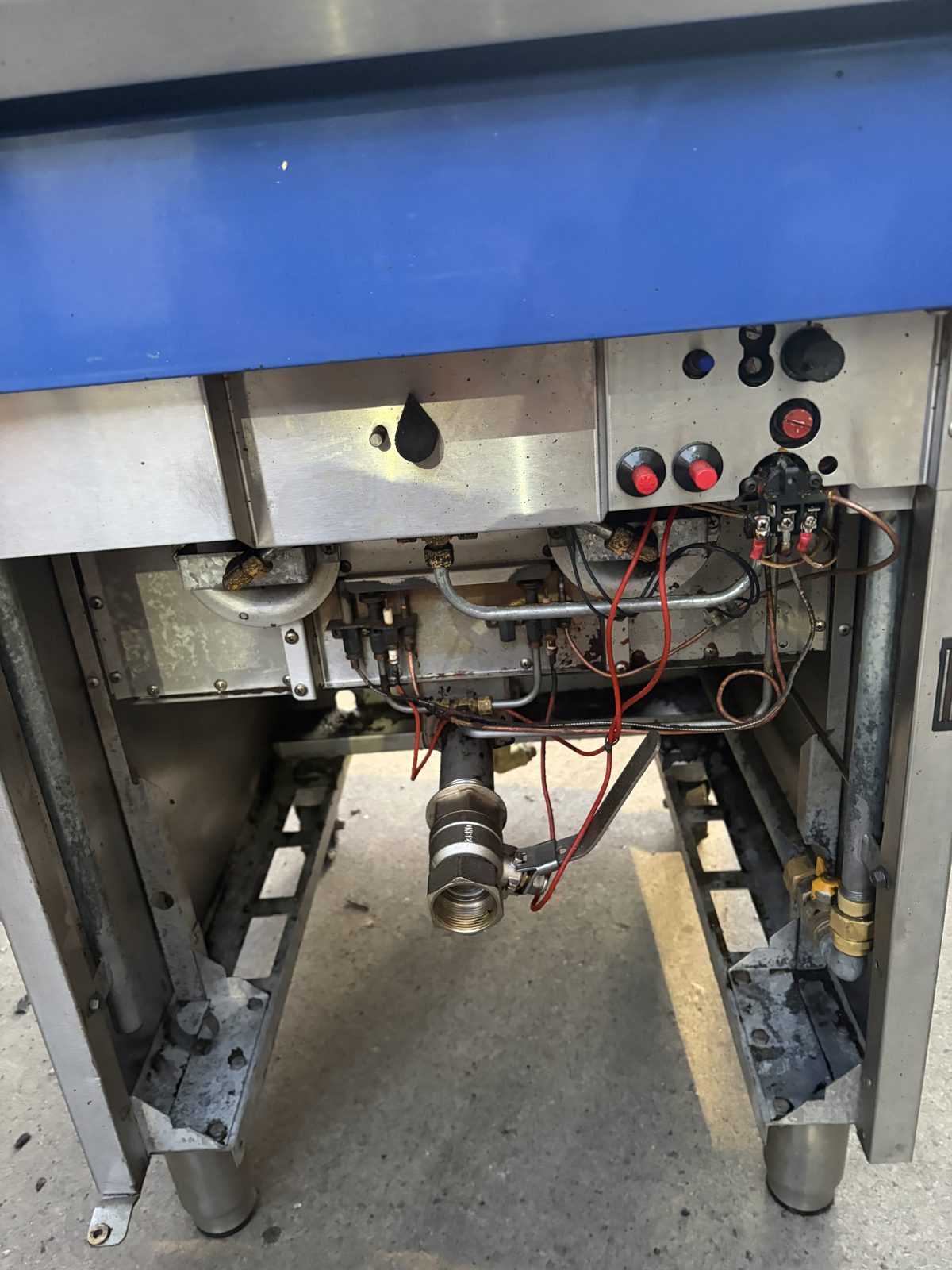
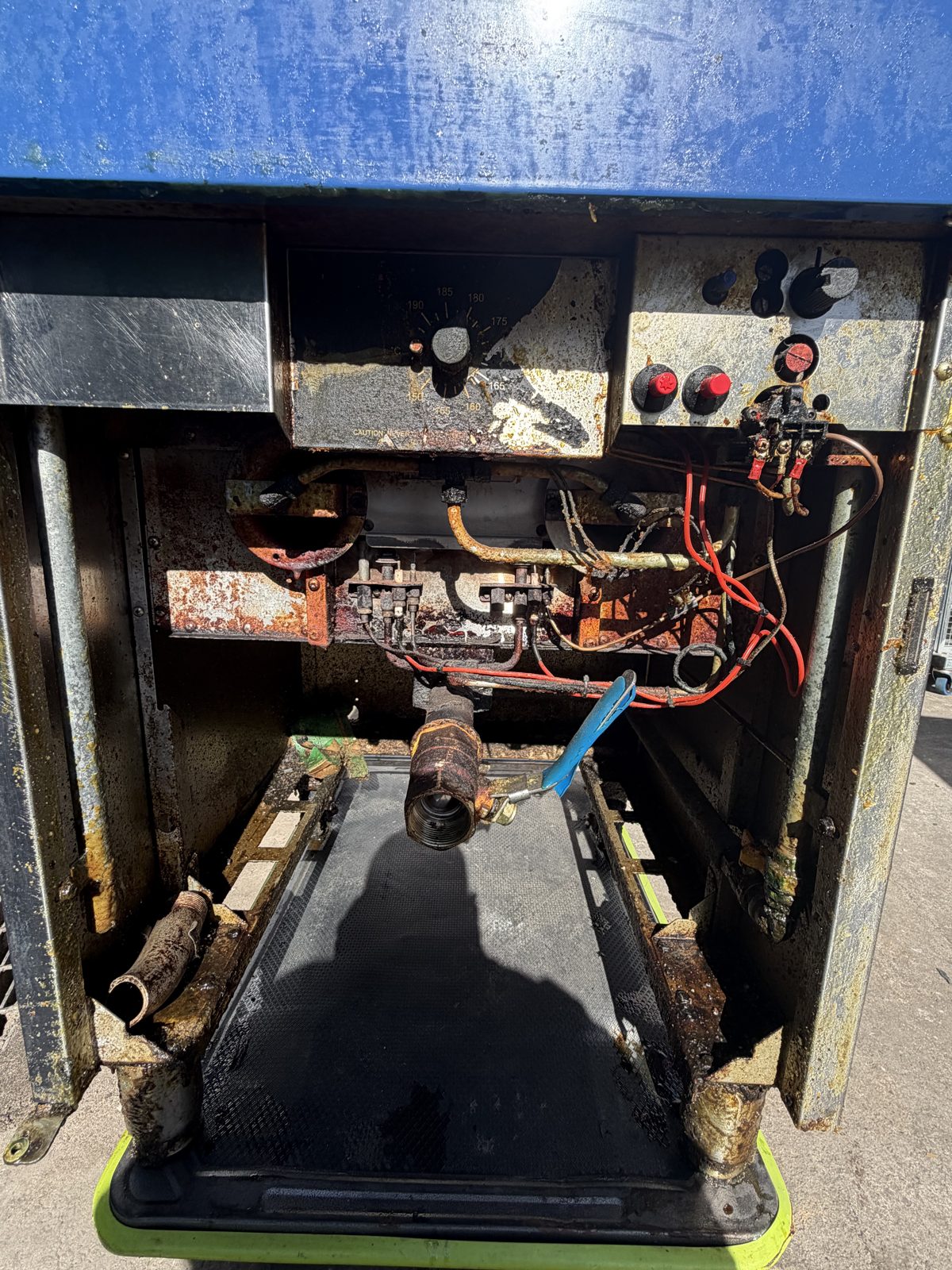
A floor-standing commercial gas fryer, in service for years and recently decommissioned because it was too dirty to keep using, caked in carbonised oil, grease and surface rust — cleaned back to bright stainless with dry ice at Shelly Beach Golf Club on the Central Coast — no water near the gas train, no caustic, no abrasive left in the vat.
Before and after
Same spot, same day. Drag the handle — Before is on the left, After on the right.
Watch it come off
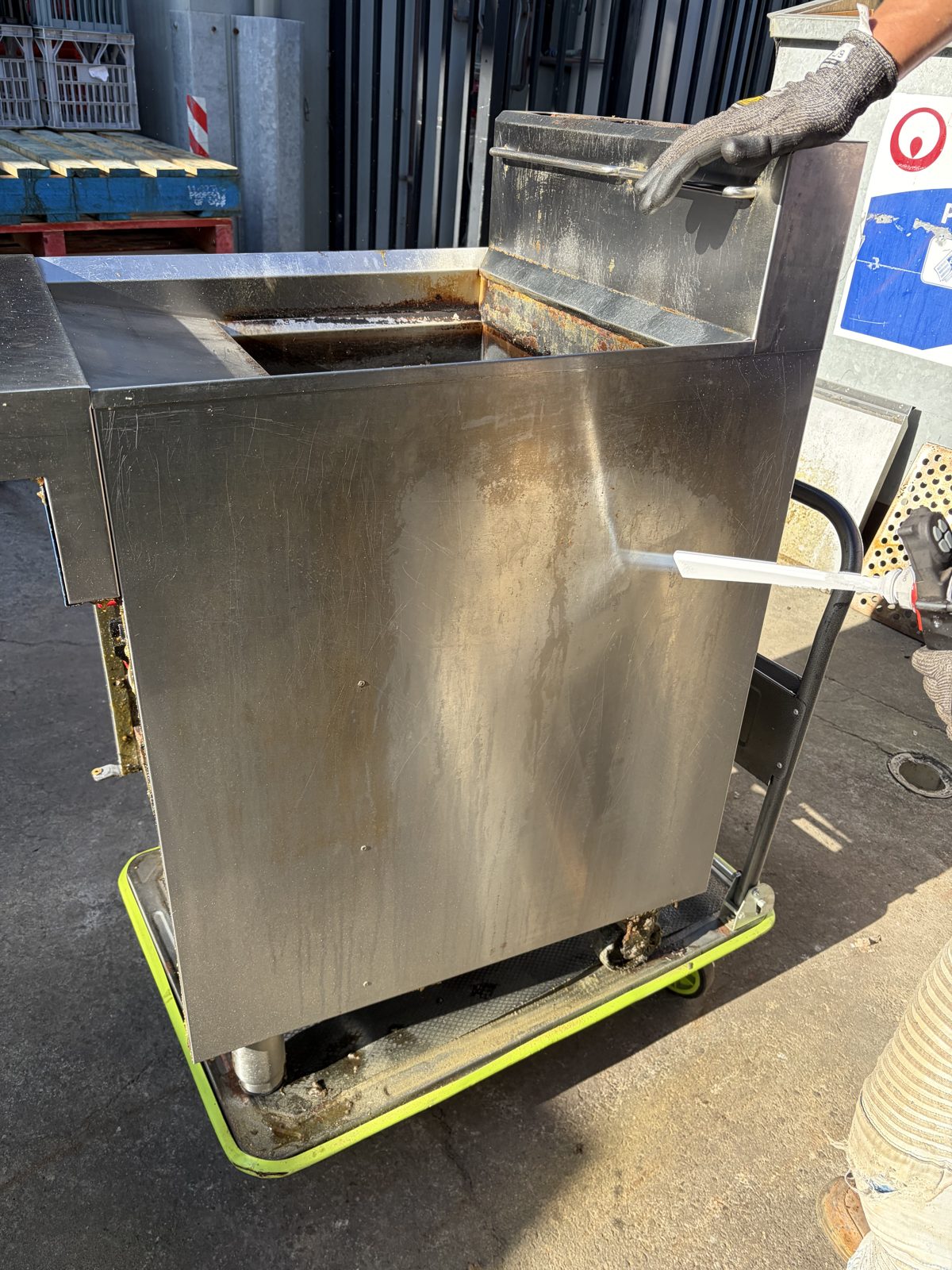
Twenty seconds at the top edge of the cabinet side panel: the nozzle starting into years of baked-on grease. No water, no chemicals — the vapour is CO₂ sublimating.
The brief
Shelly Beach Golf Club sits on the coast at Shelly Beach on the Central Coast, with a kitchen that feeds the clubhouse. Out the back they had a floor-standing commercial gas deep fryer that had worked hard for years and had recently been decommissioned — not because it was broken, but because it had become too dirty to keep using. Carbonised oil had run down every panel and baked hard, grease coated the burner bay, gas train and wiring, and surface rust had taken hold along the top rail and backsplash. As it stood it was unusable, and the usual options for a piece like this are a caustic soak, hours of scraping, or the skip.
The question was whether it could be brought back at all. The way to answer that is a test patch.
Why dry ice for a fryer
A gas fryer is a stainless box wrapped around things that must not get wet: a gas valve, a pilot assembly, a thermostat and its wiring, and the burner tubes under the vat. That rules out the pressure washer. Caustic degreasers work on grease but need rinsing, and the rinse ends up in the same places. Abrasive media — sand, soda, glass bead — would sit in the vat and the burner bay for the life of the machine.
Dry ice pellets do three things that suit this job:
- Thermal shock. The pellets hit at around −78 °C. Carbonised oil and grease contract, crack and lose their grip on the stainless underneath.
- Sublimation. The pellet turns straight to CO₂ gas on impact and expands, lifting the cracked layer off. Nothing is left behind but the grease that came off — no water, no chemical, no grit.
- Tunable pressure. Stainless panels take a firm setting. The burner bay, around the valve and the wiring, takes a much lighter one, and we mask what needs masking.
The same reasons apply to grills, salamanders, ovens, combi steamers and cool-room shelving — anything with heat, fat and electrics in one box.
The day
The fryer was wheeled out to the club’s back-of-house yard on a trolley. The rig stayed on the truck — insulated pellet bin, compressor and the Cryonomic blasting unit — with the roller door up and the blast hose run to the fryer. Hearing protection throughout.
We started with a test patch on the cabinet side, where the build-up was thickest, to set the pressure. The photo of the half-cleaned panel is from that first pass: bright stainless behind the nozzle, years of grease ahead of it. From there the sequence was the cabinet sides and top, the backsplash and rail, the vat and crumb screen, and finally the burner bay at reduced pressure — working around the gas valve, pilot and thermostat wiring rather than through them.
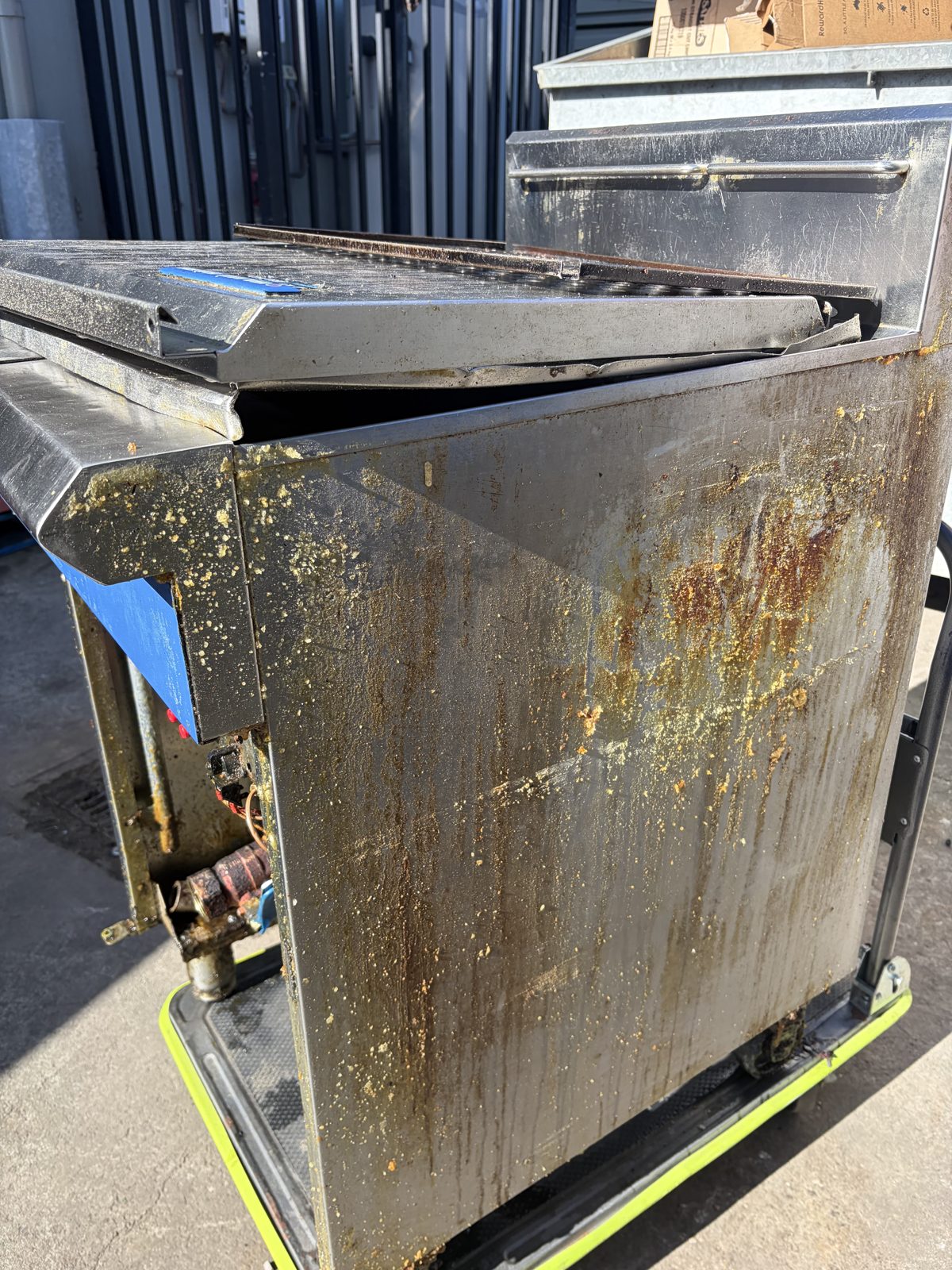
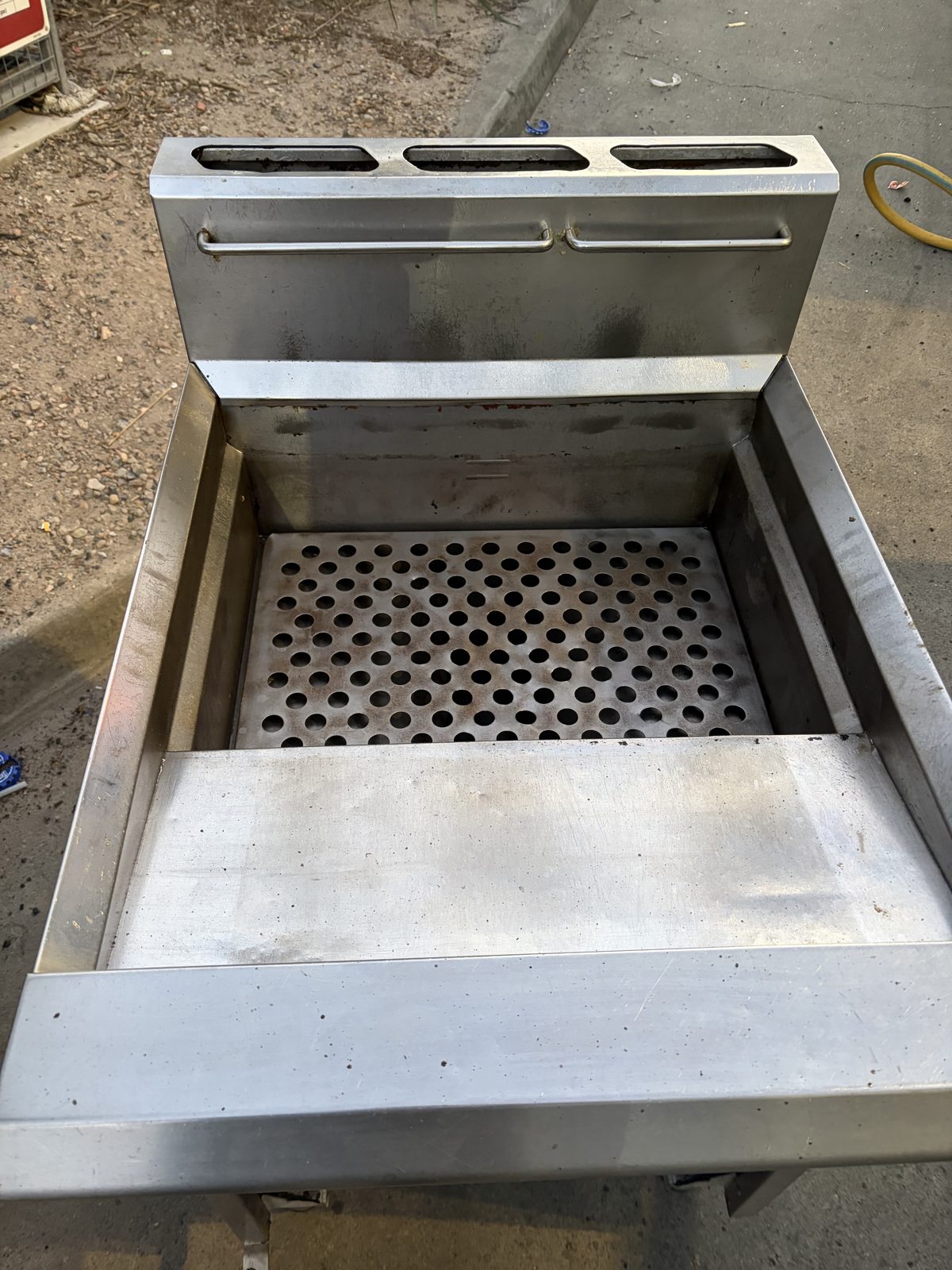
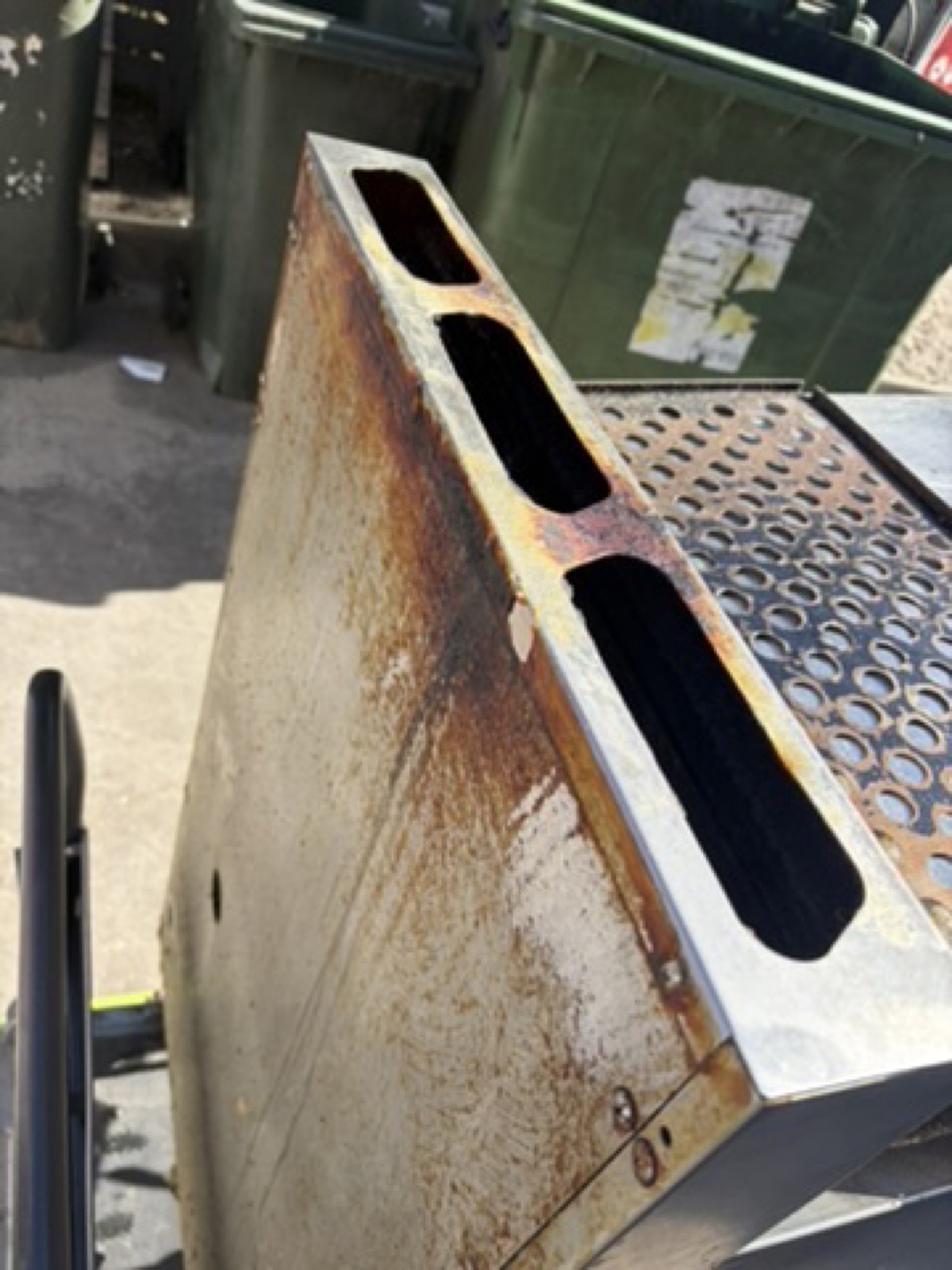
What came off: carbonised oil and grease from every external panel, baked residue from the vat, and surface rust from the rail and backsplash. What we left alone: the gas fittings and wiring, worked around at low pressure, and anything that was sound.
The result
The photos say it. Brushed stainless is back on every panel, the vat and crumb screen are bright, and the burner bay reads as a gas train and a control panel again rather than a block of grease. A fryer that was headed for the skip is in a state the kitchen can put to use.
One honest note: cleaning is our part. Before a decommissioned gas appliance is re-lit, a licensed gas fitter’s check is standard practice, and that is the kitchen’s call.
The club’s chef has been great to work with from first contact to hand-back. Their own words on the result will go here once we have them.
If you run a commercial kitchen
Clubs, pubs, cafés and restaurant kitchens across the Central Coast and Newcastle: if you have a fryer, grill, oven or cool-room that has got away from you, send us a few photos and we will quote it as a fixed price. A test patch on the day is standard practice — you see the result on your own equipment before we do the rest. We also clean food production equipment at plant scale, on the same no-water, no-chemical basis.
Photo record
Questions about this job
Can you dry ice clean a gas deep fryer?
Yes. The gas train, pilot, thermostat and wiring are the reason we use dry ice rather than water or caustic on a fryer — the pellets sublimate on contact, so nothing wet or chemical goes into the burner bay. We reduce pressure around valves and wiring and mask anything fragile.
Does the fryer have to leave the kitchen?
Not necessarily. At Shelly Beach Golf Club the fryer was wheeled out to the back-of-house yard, which gave us room and airflow. In a kitchen we can work in place with the area cleared and ventilated — we assess that on the site walk-through.
Is dry ice safe for food-contact equipment?
Dry ice is solid CO₂. It leaves no residue, no chemical film and no abrasive grit in the vat or on the surfaces food will touch — the only thing on the ground afterwards is what came off the equipment. A normal wash-down before use is still the kitchen's call.
How long does a fryer take, and what does it cost?
It depends on the build-up. This fryer had years of carbonised oil on it and was a heavy clean for a single piece of equipment. Send us a few photos and we will quote it as a fixed price.
Got something that needs the same treatment?
Send a few photos and we will come back with a fixed quote within 24 hours.
Or talk to us directly
- 02 5302 6367
- office@dryiceblasters.com.au
- Mon–Fri 7am–6pm · Sat 8am–2pm · Sun by appointment